


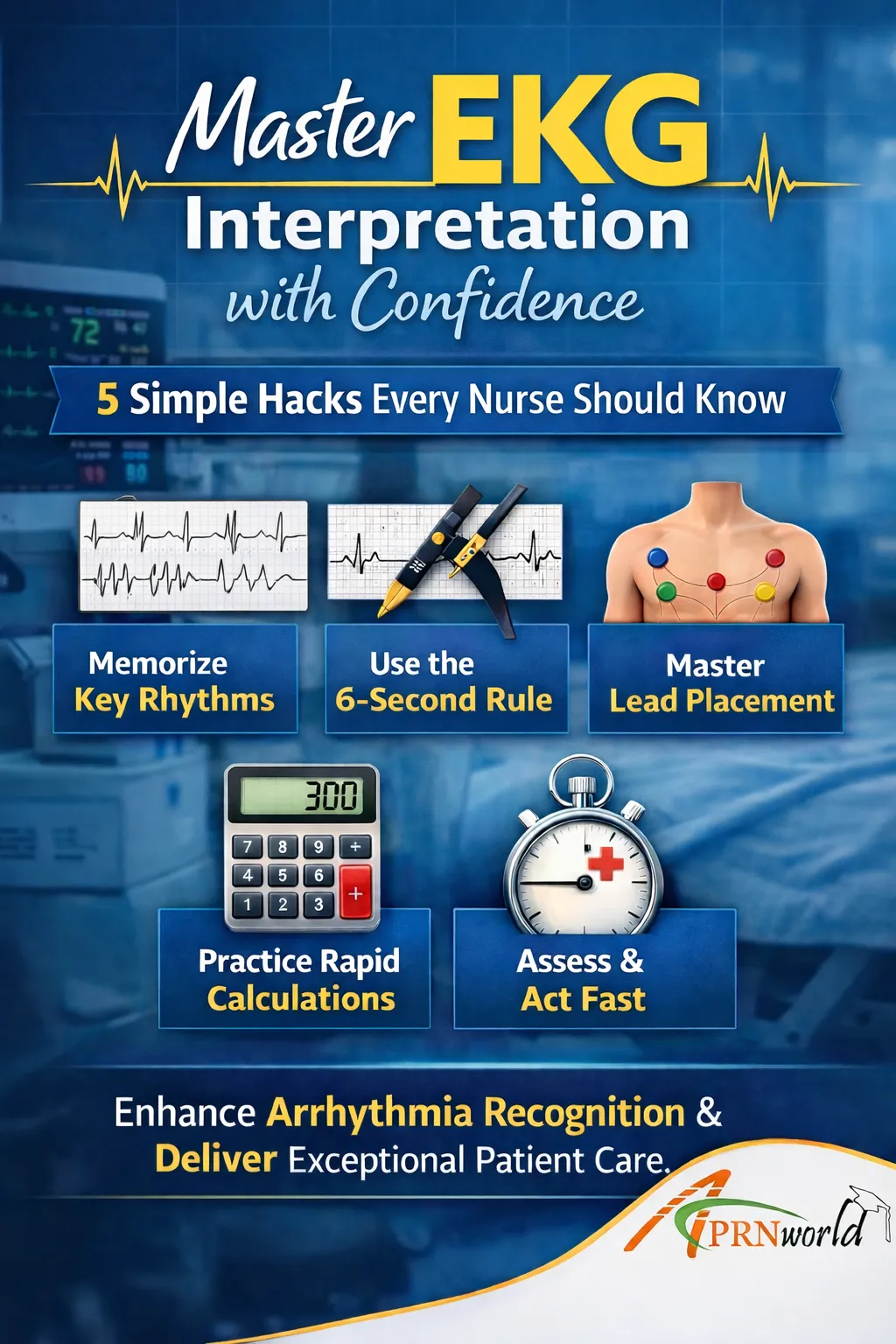
5 Simple Hacks for Accurate EKG Interpretation
Are you struggling with EKG interpretation?
Accurate EKG interpretation is a lifesaving responsibility; it’s more than just a clinical skill. Mastering the key components of an EKG strip including P-Waves, QRS Complexes, and T-Waves is very important to understand the cardiac function and to detect cardiovascular abnormalities.
APRN World Helps To Enhance Your Diagnostic Capabilities With Systematic Approach
·Identify potential arrhythmias by measuring the distance between R-R intervals to identify irregularities in heart rhythms.
·Count the R peaks in a 6-second EKG strip and then multiply that number by 10 to asses the heart rate. This helps in evaluating the patient stability.
·Atrial fibrillation or other arrhythmias can be recognized by detecting the absence or abnormalities in P signals. This must be verified before each QRS complex.
·A delay in conduction through the atrioventricular (AV) node can be identified by measuring the PR interval.
·A bundle branch block or other conduction abnormalities can be identified by analyzing the QRS Complex. Ischemia or electrolyte imbalances can be identified by examining the T waves.
Overcoming Noise Interference and Enhancing Signal Clarity in EKG Analysis
Noise reduction is an inevitable factor in achieving accuracy in EKG strip analysis. Consider the following strategies helps to effectively address the common sources of noise.
·Minimize motion artifacts with right placement of electrode on the skin.
·Reduce high-frequency noise by employing advanced digital filtering techniques. This helps to enhance signal clarity by isolating true cardiac signals from artifacts.
·Eliminate equipment-related noise with routine calibration and maintenance of EKG machines.
·Patient preparation is important to minimize muscle movement artifacts.
All the above strategies helps to improve the quality of EKG strip readings.
Why EKG Interpretation Skills Matter for Nurses?
Accurate EKG interpretation is inevitable for ICU, emergency departments, telemetry units, and cardiac care units.
Advanced EKG and arrhythmia training helps nurses:
Effectively diagnose initial life-threatening cardiac rhythms
Improve critical thinking skills
Strengthen patient monitoring capabilities
Deliver exceptional patient care
Advance Your EKG Interpretation Skills With APRN World At Low Cost
Our evidence-based training is designed to help RNs, APRNs, and NPs confidently interpret cardiac rhythms and deliver exceptional patient care.
Stay confident. Stay accurate. Deliver exceptional patient care.
Frequently Asked Questions (FAQ)
1. Why is accurate EKG interpretation important for nurses?
Accurate EKG interpretation for nurses is essential because it helps detect life-threatening arrhythmias early. Prompt recognition allows timely intervention, improves patient safety, and reduces the risk of cardiac complications in critical care settings.
2. How can nurses improve their EKG interpretation skills?
Nurses can improve EKG interpretation skills by:
Following a systematic step-by-step approach
Practicing daily with rhythm strips
Understanding normal EKG values
Learning pattern recognition
Enrolling in an advanced arrhythmia continuing education course
Consistent practice and structured training significantly enhance diagnostic accuracy.
3. What is the easiest way to calculate heart rate on an EKG?
For regular rhythms, use the 300 rule (300-150-100-75-60-50 method).
For irregular rhythms, count the QRS complexes in a 6-second strip and multiply by 10.
This method ensures fast and accurate heart rate calculation in clinical settings.
4. How does arrhythmia certification benefit career growth?
Arrhythmia certification:
Enhances clinical credibility
Improves promotion opportunities
Strengthens critical care competency
Increases confidence in emergency situations
Demonstrates commitment to professional development
