


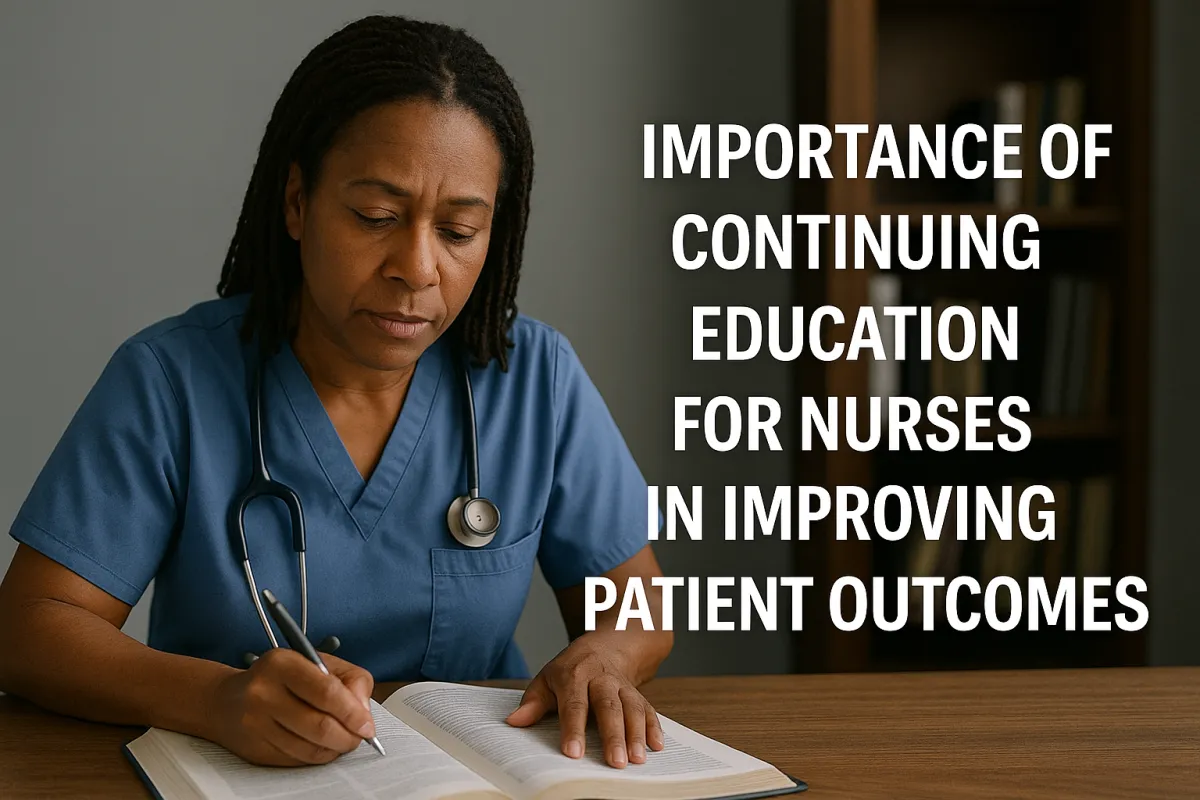
Importance of Continuing Education for Nurses in Improving Patient Outcomes
As care complexity rises, continuing education (CE) equips nurses with current, evidence-based skills that translate into safer care, fewer errors, and higher patient satisfaction. Systematic reviews of continuing professional development (CPD) show measurable changes in clinician behavior and, in many syntheses, improvements in patient outcomes—especially when education is interactive, case-based, and reinforced over time. Lippincott JournalsBioMed Central
How CE Improves Patient Outcomes
1) Fewer preventable harms (errors and infections).
Targeted education—such as medication-safety refreshers, simulation, and audit-and-feedback—has been linked to reductions in medication administration errors and better safety compliance on acute units. Parallel reviews of nurse-led infection-prevention education report significant drops in healthcare-associated infection (HAI) rates and improved adherence to prevention bundles. ScienceDirect+1Lippincott JournalsMDPI
2) Faster uptake of best practices.
CPD accelerates practice change: reviews of CE/CME find that structured, multimodal programs (eLearning plus interactive workshops, reminders, and feedback) are more likely to shift day-to-day behaviors that matter for outcomes than passive lectures alone. PMCLippincott Journals
3) Better quality, safety, and patient experience.
Nursing CPD is consistently associated with higher quality of nursing care, stronger patient safety culture, and even lower organizational costs through avoided complications—benefits sustained when organizations create time, mentoring, and recognition for learning. ScienceDirect
4) Workforce capability and retention.
Nurses describe CPD as essential to professional identity, confidence, and decision-making—factors that underpin reliable, compassionate care at the bedside. Engagement improves when employers provide supportive learning environments and align topics to real clinical challenges. PMC+1
What “Good” Nursing CE Looks Like (Evidence-Informed)
Interactive & case-based: scenarios, skills practice, and feedback outperform passive sessions. PMC
Multimodal & continuous: blended eLearning + live workshops + reminders sustains change. Lippincott Journals
Unit-specific & measurable: tie content to priority harms (med errors, CAUTI/CLABSI, falls) and track process/outcome metrics. ScienceDirect
Supported by leadership: time, coaching, and recognition drive participation and impact. PMC
APRN WORLD: CE That Moves the Needle
APRN WORLD’s cost-effective, visually engaging, and clinically relevant CE aligns with what the literature says works: interactive micro-modules, case simulations, and unit-level scorecards tied to outcomes such as med-error rates, infection trends, and patient experience metrics. This helps teams convert new knowledge into safer practice—fast. (Ask us about bundles for medication safety and HAI prevention mapped to your unit’s KPIs.)
Selected Research You Can Reference
Academic Medicine (2021): Umbrella review—two-thirds of syntheses report clinician behavior change and/or patient outcome improvements with CPD, especially multimodal programs. Lippincott Journals
Cochrane Review Update (2021): Continuing education meetings/workshops improve professional practice; interactive formats outperform didactic only. PMC
Nurse-focused CPD Review (2021): CPD improves quality of nursing care, patient safety, satisfaction, and can reduce costs. ScienceDirect
Medication-Error Education Reviews (2022–2025): Educational interventions for nurses reduce med-admin errors and strengthen safety culture/compliance in acute care. ScienceDirectLippincott Journals
HAI Prevention Reviews (2024–2025): Educational components within nursing interventions are linked to lower HAI incidence and better adherence to prevention protocols. ScienceDirectMDPI
Nurses’ Perspectives (2021–2024): CPD is seen as fundamental to professionalism; participation rises with supportive culture and relevant topics. PMC+1
